pir8g33k
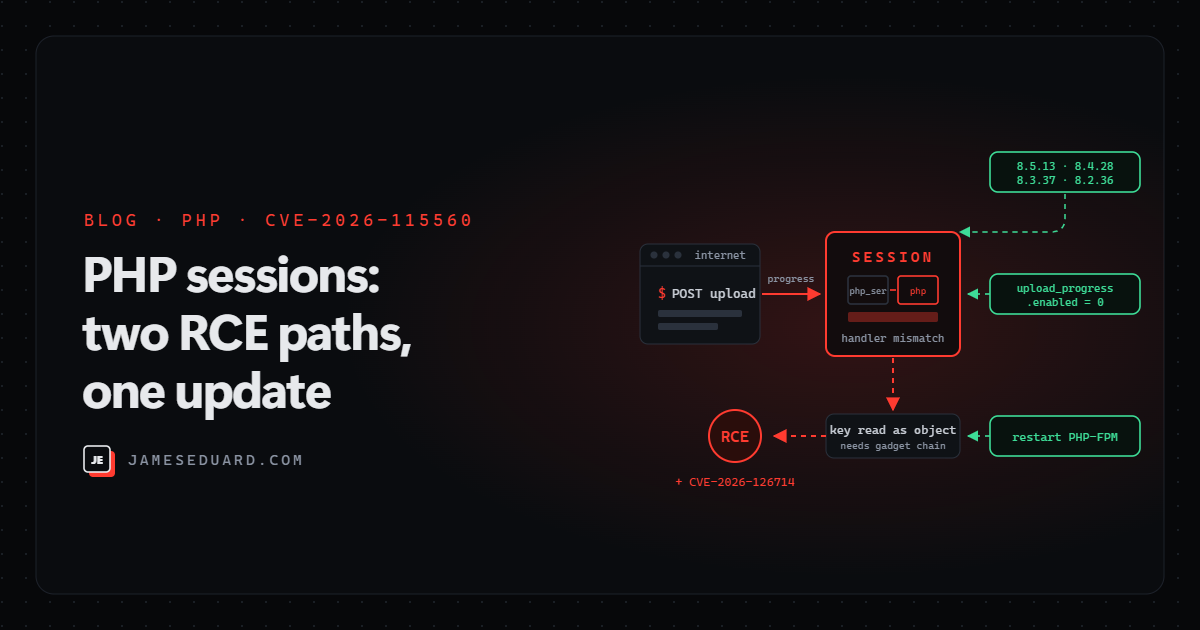
TL;DR: On 19 November 2026 PHP shipped security releases 8.5.13, 8.4.28, 8.3.37 and 8.2.36 (plus the new 8.6.0). The headline fixes are two session bugs that can lead to remote code execution: CVE-2026-115560 (session serializer mismatch, first flagged on 23 October) and CVE-2026-126714 (partially overwritten session files). PHP rates the release critical, but says the critical issues need a non-default configuration or an uncommon setup. No attacks on these two have been reported yet. This comes four weeks after PHP2Shell, which attackers hammered within hours, so update PHP and restart PHP-FPM / Apache now. If you can’t, set session.upload_progress.enabled = 0.
PHP runs a big slice of the web: WordPress, Drupal, Magento, Laravel apps, control panels and a lot of in-house tools. After PHP2Shell in October, attackers are clearly paying attention to PHP’s session and request-handling code. Here’s what the 19 November release fixes, how to tell whether you’re exposed, and how to patch or contain it.
What was fixed
The PHP team announced the release on 18 November as an “upcoming critical security release” and shipped it on 19 November as part of its regular four-week cycle. The changelog lists more than a dozen security fixes. The ones that matter most for server admins:
| CVE | Area | What it is |
|---|---|---|
| CVE-2026-115560 | Sessions | Session serializer mismatch can lead to RCE (the 23 October “session upload progress” advisory) |
| CVE-2026-126714 | Sessions | Partially overwritten session files can lead to RCE |
| CVE-2026-129481 | Sessions | Use-after-free after an interrupted session shutdown, described as an incomplete fix for PHP2Shell’s CVE-2026-109619 |
| CVE-2026-129538 | PHP-CGI | Out-of-bounds read/write in PATH_INFO correction |
| CVE-2026-129289 | PHP-FPM | Request smuggling through an unread request body |
| CVE-2026-129291 | PHP-FPM | epoll use-after-free, local privilege escalation |
| CVE-2026-129292 | PHP-FPM | XSS in the FPM status page |
| CVE-2026-128090 | PHAR | OpenSSL signature bypass via algorithm downgrade |
| CVE-2026-129496 | Date | Timezone cache use-after-free can lead to RCE |
There are also SOAP, DOM, HTTP stream and URI fixes. Some Core and URI fixes apply only to 8.5 and 8.6. Check the official changelog for the full list per branch.
Affected and fixed versions
| Branch | Vulnerable | Fixed in | Notes |
|---|---|---|---|
| PHP 8.5 | 8.5.12 and earlier | 8.5.13 | Security release |
| PHP 8.4 | 8.4.27 and earlier | 8.4.28 | Security release |
| PHP 8.3 | 8.3.36 and earlier | 8.3.37 | Security release |
| PHP 8.2 | 8.2.35 and earlier | 8.2.36 | End of life 31 December 2026: plan your upgrade |
| PHP 8.6 | n/a | 8.6.0 | New GA release, includes the same fixes |
| PHP 8.1 and older | Yes | No release | No longer supported by the PHP project. Use a vendor with extended support or upgrade. |
How the session bug works
PHP stores session data using a “serialize handler”. There are three formats: php, php_binary and php_serialize. CVE-2026-115560 needs all three of these to be true:
- The server config sets
session.serialize_handlertophp_binaryorphp_serialize. - The application switches it to
phpat runtime withini_set()before callingsession_start(). session.upload_progress.enabledis still on, which is the default.
When the handlers don’t match, data an attacker controls through a file-upload request can end up in the session in one format and be read back in another. Part of a session key can then be treated as object data. Whether that becomes code execution depends on the application: it needs a usable object “gadget chain”. Without one, the likely result is a corrupted session or a crash. CVE-2026-126714 is a separate path in the same area, where a partially overwritten session file can lead to code execution.
An app that never changes the serialize handler at runtime isn’t exposed to CVE-2026-115560. That’s why PHP says the critical issues need non-default configuration or uncommon setups. Don’t treat that as a reason to wait, though. The fix is a routine minor update, and you can’t always see what third-party plugins do with ini_set().
Is it being exploited?
As of 20 November there are no public reports of attacks on CVE-2026-115560 or CVE-2026-126714, and neither is on CISA’s KEV list. The context is what makes me treat this as urgent. PHP2Shell (CVE-2026-109618 and CVE-2026-109619) was patched on 21 October, and AWS reported attacks starting days before the patch. Cloudflare saw tens of thousands of attempts within 45 minutes of disclosure, and the volume reached millions by the next day. Reports say most of that activity was scanning and broken exploits. Even so, attackers will diff this release quickly.
Step 1: check whether you’re exposed
Get the version first. Remember that the CLI and PHP-FPM can be different builds with different ini files, so check the one that actually serves web traffic.
# CLI and FPM versions (binary names vary by distro, e.g. php-fpm8.3)
php -v
php-fpm -v 2>/dev/null || ls /usr/sbin/php-fpm*

# exact package versions (Debian/Ubuntu, then RHEL/Rocky/Alma)
dpkg -l 'php*' 2>/dev/null | grep '^ii' | grep -E 'common|fpm|cli'
rpm -qa 'php*' 2>/dev/null | grep -E 'common|fpm|cli'
Then look at the session settings and at whether your code switches the handler at runtime:
# effective session settings (CLI view)
php -i | grep -E 'session.serialize_handler|session.upload_progress.enabled'

# settings in FPM pools and php.ini files
grep -rnE 'serialize_handler|upload_progress' /etc/php* /etc/php-fpm.d 2>/dev/null

# app code that changes the handler at runtime (adjust the web root)
grep -rnE "ini_set\(\s*['\"]session\.serialize_handler" /var/www 2>/dev/null
Also check two things the other fixes touch. Is PHP running as CGI (php-cgi) anywhere? And is the PHP-FPM status page (pm.status_path) reachable from outside?
ps -eo pid,user,cmd | grep -E '[p]hp-cgi|[p]hp-fpm'
grep -rn 'pm.status_path' /etc/php* /etc/php-fpm.d 2>/dev/null
If you onboard Linux servers to Microsoft Defender for Endpoint, Defender Vulnerability Management can list PHP versions across the estate in Advanced Hunting:
DeviceTvmSoftwareInventory
| where SoftwareName has "php"
| summarize Devices = dcount(DeviceId) by SoftwareVendor, SoftwareName, SoftwareVersion
| order by Devices desc
Step 2: patch, then restart
Upgrade to 8.5.13, 8.4.28, 8.3.37 or 8.2.36, or to your distribution’s package that includes these fixes. Distros backport, so compare against your vendor’s advisory rather than the upstream version number alone.
# Debian/Ubuntu (distro or ondrej/sury repo)
sudo apt update && sudo apt install --only-upgrade 'php*'
# RHEL/Rocky/Alma (AppStream or Remi)
sudo dnf upgrade 'php*'

# old code keeps running until the workers restart
sudo systemctl restart php8.3-fpm     # or php-fpm, match your unit name
sudo systemctl restart apache2        # if you use mod_php (httpd on RHEL)
php -v- Containers: rebuild images based on
php:tags and redeploy. A running container keeps the old PHP. - Hosting panels and appliances: cPanel, Plesk, CloudPanel and similar products ship their own PHP builds, so they need the vendor’s update.
- PHP 8.1 and older: the project no longer ships fixes. Use a vendor with extended support or move to a supported branch.
Step 3: can’t patch today? Contain it
PHP’s own workaround for CVE-2026-115560 is to turn off session upload progress. This was already the recommended mitigation for PHP2Shell’s CVE-2026-109619, so keep it if you set it in October. It has to apply before the request is parsed. Put it in php.ini or the FPM pool, not in ini_set() or .user.ini:
# php.ini
session.upload_progress.enabled = 0

# or per PHP-FPM pool (e.g. /etc/php/8.3/fpm/pool.d/www.conf)
php_admin_value[session.upload_progress.enabled] = 0

# then restart every PHP worker
sudo systemctl restart php8.3-fpm
Very few apps use upload progress bars, but test any file-upload pages afterwards. According to watchTowr’s analysis, this setting reduces exposure but doesn’t fully protect against CVE-2026-126714, so treat it as a bridge to the patch. While you’re in there:
- Remove runtime
ini_set('session.serialize_handler', ...)calls, or make the config and the code use the same handler. - Restrict the FPM status page to localhost or your monitoring hosts.
- Don’t expose
php-cgidirectly to the internet. Use PHP-FPM instead.
Checklist
- ☐ Inventory every PHP runtime: servers, containers, hosting panels, appliances.
- ☐ Upgrade to 8.5.13 / 8.4.28 / 8.3.37 / 8.2.36 (or your distro’s fixed package) and restart FPM or Apache.
- ☐ Set
session.upload_progress.enabled = 0anywhere you can’t patch today. - ☐ Search your code for runtime changes to
session.serialize_handler. - ☐ Lock down the FPM status page and retire any internet-facing
php-cgi. - ☐ Confirm the October PHP2Shell fixes (8.5.12 / 8.4.27 / 8.3.36 / 8.2.35 or later) are in place everywhere.
- ☐ Plan the move off PHP 8.2 (EOL 31 December 2026) and anything older.
- ☐ Watch for PHP-FPM worker crashes (
SIGSEGV,exited on signal) and unusual multipart upload traffic.
References
- PHP news archive: 18 Nov notice, 19 Nov releases, 23 Oct session advisory
- PHP 8 ChangeLog
- watchTowr: PHP CVE-2026-115560 FAQ
- Aikido: PHP critical security release, 19 November
- BleepingComputer: PHP shares mitigation for new RCE
- Security Affairs: PHP warns of new code execution flaw
Facts as of 20 November 2026. Exploitation status and distro packages will change, and I’ll update this post when they do.