 pir8g33k
Four months. That’s how long it took ARTEX to go from a GitHub project to the subject of an FBI warning.
ARTEX is an AI tool built for penetration testing, the kind of work companies pay security teams to do so they can find their weak spots before criminals do. You give it a target and a goal, and a group of AI agents does the rest: they look around, find a way in, and try to get admin access, mostly without a human touching the keyboard. That’s useful for defenders. Unfortunately, it’s just as useful for attackers, and they noticed.
From open-source project to attack tool
A developer published ARTEX on GitHub in mid-2026 as a free, open-source project. By October the developer had taken the public code down after saying people were misusing it. By then it didn’t matter. Copies, translated versions and even a paid “Pro” edition were already circulating.
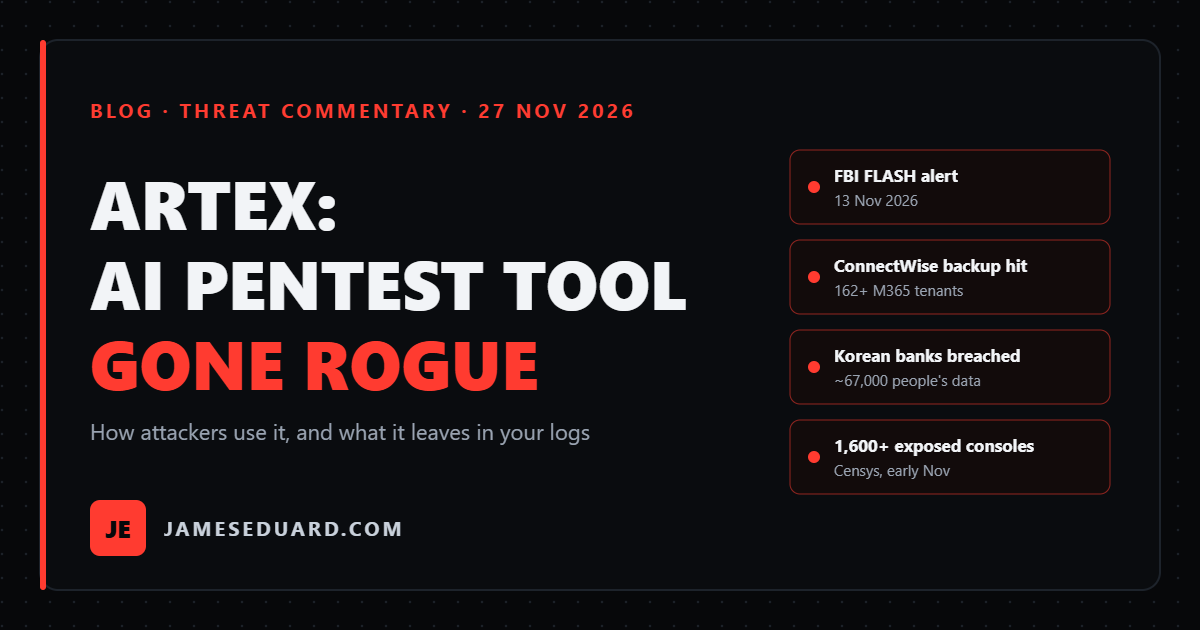
On 13 November the FBI issued a FLASH alert saying attackers had been using ARTEX since at least August, against everything from banks and hospitals to government, energy and telecoms. In some cases they went from first contact to full control in under three hours. The line in the FBI’s warning that worries me most is that the tool lets people “with minimal technical expertise” run complex attacks against many targets at once.
Who is using it
Pretty much everyone, from state-backed hacking groups to ordinary criminals. A few cases have made the news:
- In October, attackers got in through a cloud backup service (ConnectWise Cloud Backup) and reached at least 162 Microsoft 365 customer environments, then tried to get into more than 2,250 others.
- In South Korea, attackers went after major banks and took personal data on about 67,000 people. Korean police have since arrested seven people linked to attacks on more than 90 organisations.
- One espionage group targeted more than 200 organisations across 14 countries in under two weeks.
Microsoft, Google, CrowdStrike and others have linked several of these campaigns to China-based groups, though the companies don’t agree on every detail yet.
Why this matters
ARTEX doesn’t do anything a skilled hacker couldn’t already do. Microsoft says so directly. What changes is speed and cost. SentinelOne estimates a whole campaign costs somewhere between $145 and $1,500 in AI usage. Work that used to need an experienced team and weeks of effort can now be pointed at hundreds of companies in an afternoon.
And blocking it at the AI level doesn’t seem to work. Researchers saw attackers try the big US AI models, get refused, and simply switch to cheaper models that didn’t say no. So I don’t think we can count on AI companies to solve this one for us.
What it means for the rest of us
The good news is that ARTEX mostly gets in through the same old gaps: weak or reused passwords, old access keys nobody rotated, forgotten apps with too many permissions, and login or password-reset pages with no limits on how often they can be tried. Fixing those has always been good advice. It’s just more urgent now, because the gap between “we’ll fix it next quarter” and “someone already got in” has shrunk to hours.
If you look after IT for a business, now is a good time to check who and what has access to your Microsoft 365 or cloud accounts, clean out anything you don’t recognise, and make sure your security team or provider knows about ARTEX. Banks in Korea and Japan have already been hit, so I’d expect the rest of Asia, Hong Kong included, to be on someone’s list. Suspicious activity can be reported to HKCERT here, or to the FBI’s IC3 if you’re in the US.
Disclosure: I keep an English translation of the ARTEX code on my GitHub for research (pir8g33k/ARTEX-BaaRai).
Sources
- Microsoft Threat Intelligence: What defenders need to know about ARTEX (25 Nov 2026)
- Google Threat Intelligence Group: ARTEX and Friends (30 Oct 2026)
- Unit 42: ARTEX and AI-Powered Red Teaming Tools (11 Nov 2026)
- SentinelOne: ARTEX Unmasked (13 Nov 2026, updated 23 Nov)
- BleepingComputer: FBI warns ARTEX AI hacking tool is powering global cyberattacks (15 Nov 2026)
- The Record: FBI flash alert says Artex tool automating cyberattacks at “machine speed” (13 Nov 2026)
Written on 27 November 2026 from the reports above. Some details differ between them and may change.