pir8g33k
TL;DR: In just a few weeks, Hong Kong has seen breaches at Sogo, Chow Sang Sang, HKMU and the exams authority, a privacy ruling against the Hospital Authority, and investigations into three airlines and two electronics retailers. My view is that this isn’t bad luck. It’s the same few weaknesses over and over: membership databases that keep everything forever, vendors with too much access, and a privacy law that still doesn’t require companies to report breaches. Below is what I’d fix first if I were running security at one of these companies, and what you can do as a customer.
If you live in Hong Kong, there’s a good chance at least one of this month’s breach notices was about you. Every few days another familiar brand is sending “we detected unauthorised access” emails, and the follow-up scam calls aren’t far behind. I work on the defensive side of this every day, so I want to share what I see behind the headlines.
What happened this autumn
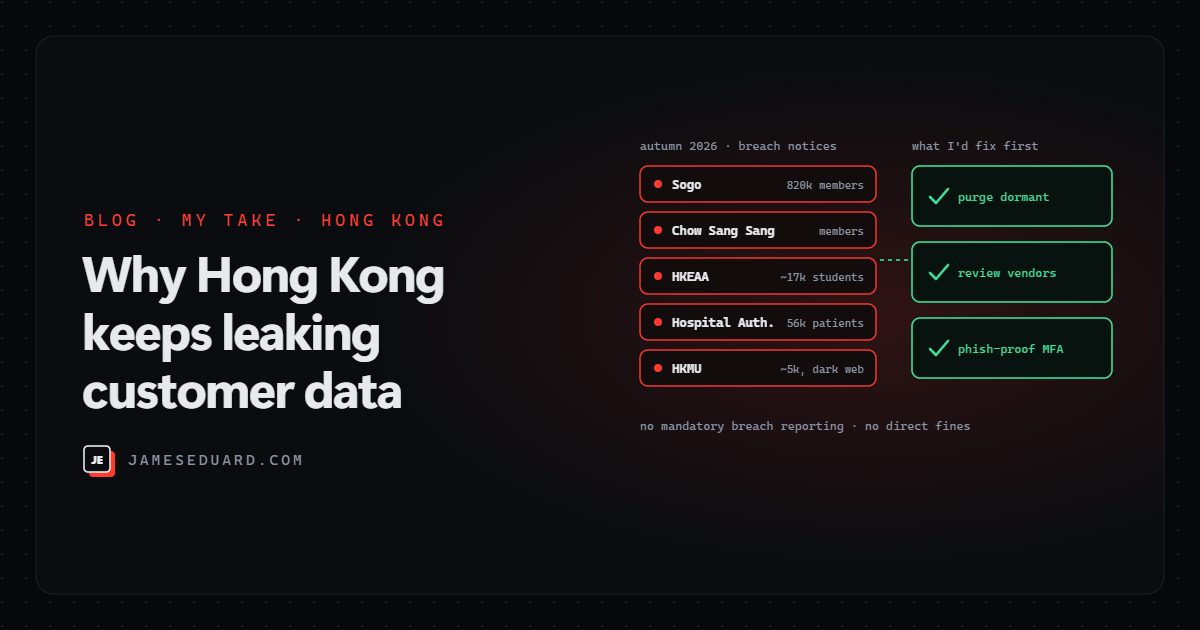
- Sogo: unauthorised access to its membership system, with up to 820,000 loyalty members potentially exposed.
- Chow Sang Sang: detected unauthorised access on 9 November, with customer and employee data from its membership and e-commerce systems possibly taken. It reported the incident to the privacy regulator and the police.
- HKMU: about 5,000 people may be affected, with data allegedly offered for sale on the dark web.
- HKEAA: data of nearly 17,000 mainland students who registered for two international exams was leaked.
- Hospital Authority: the Privacy Commissioner ruled it breached the law after a vendor employee leaked personal data of 56,243 patients.
- Airlines and retailers: the PCPD is formally investigating Cathay Pacific, Hong Kong Airlines, Malaysia Airlines, YOHO and Broadway. Almost 2,000 customers of Hong Kong Airlines and two appliance retailers received suspected scam calls after the leaks.
The bigger picture matches. HKCERT recorded 4,404 security incidents in Q3 2026, about 15% more than a year earlier, with phishing the main threat. The PCPD received 246 breach notifications in 2025, up 21%, and those are only the ones companies chose to report.
Why it keeps happening (my take)
1. Loyalty programmes keep everything, forever
Look at which systems were breached: membership systems, e-commerce accounts, loyalty databases. These are built to collect, not to forget. The PCPD’s ImagineX ruling said it plainly: the breach came from not deleting inactive accounts and not updating outdated systems. A customer who last bought a handbag in 2017 shouldn’t still be a full record in a system that’s reachable from the internet. Data you don’t keep can’t leak.
2. Vendors have more access than anyone checks
The Hospital Authority case wasn’t an outside attacker. It was a vendor employee, and the regulator found weak monitoring of vendor access, missing role-based controls and too few audits. I see the same thing in assessments: a contractor account created for a project three years ago that still has broad read access and no one is watching it.
3. The law makes reporting optional
Hong Kong still has no mandatory breach notification, and the PCPD can’t fine a company directly: money penalties need a court conviction. Mandatory reporting and fines have been proposed since 2020 but not passed. Meanwhile the new critical infrastructure law (Cap. 653), in force since 1 January 2026, only covers designated operators of critical systems, not retailers or universities. When there’s little downside to a breach, security budgets lose to marketing budgets.
4. The breach is just step one: the scam is step two
Names, phone numbers and membership details are exactly what scammers need to sound convincing. The airline and retailer cases already turned into scam calls. Treat any call or SMS that mentions a recent order, flight or membership right after a breach notice as suspicious by default.
What I’d fix first
If I had one quarter and a normal budget at a Hong Kong retailer or school:
- Delete or archive dormant members. Set a retention period (for example, three years of inactivity), then purge or move old records offline. Stop collecting full HKID numbers where you don’t legally need them.
- Review every vendor and contractor account. Remove the ones no longer needed, limit the rest to what they need, and alert on bulk exports.
- Put phishing-resistant MFA on admin and remote access (FIDO2 keys or passkeys), especially for anyone who can reach the membership database.
- Monitor the crown-jewel database. Alert on unusual query volume, new admin logins and large data transfers. The sooner you spot unusual access, the less data leaves.
- Write the breach playbook before you need it: who decides, who calls the PCPD and HKCERT, and a pre-written customer notice that includes a scam warning.
What you can do as a customer
- Use a unique password for every loyalty and shopping account (a password manager makes this easy), and turn on MFA where it’s offered.
- Delete accounts with shops you no longer use. Most have an account deletion option or a privacy contact.
- Be extra careful with calls and messages after a breach notice. Hang up and call the company back on its official number.
- Think twice before giving your HKID number for a membership. You can ask why it’s needed.
I’ll keep tracking these cases. If you want the technical, team-level version with detection ideas, I’m putting together a Hong Kong breach roundup for Kage Security Lab’s Threat Intel.
References
- SCMP: 820,000 Sogo members at risk as Sogo and Chow Sang Sang hit by data breaches
- MLex: Chow Sang Sang says customer, employee data accessed
- SCMP: 5,000 people linked to HKMU may have had data leaked
- SCMP: Data of nearly 17,000 students leaked in exams authority breach
- MLex: Hospital Authority breached privacy law in data leak
- The Standard: PCPD investigates airlines and appliance retailers
- SCMP: 2,000 customers get scam calls after data breaches
- The Standard: ImagineX found at fault for data breach
- HKCERT: Q3 2026 incident statistics
- PCPD e-Newsletter, February 2026: 246 breach notifications in 2025
- HKSAR Government: Critical Infrastructures Ordinance in effect from 1 January 2026
Facts as of 20 November 2026. Several of these investigations are still open, so numbers may change.